How to create and sell custom products online

How to create and sell custom products online
Custom products are defined as goods personalised to a buyer’s specifications, and they represent one of the fastest-growing categories in online retail. The ability to create and sell custom products has shifted dramatically with AI-driven platforms that generate print-ready files, listing visuals, and product descriptions in minutes rather than weeks. Aspiring entrepreneurs no longer need large upfront stock orders or expensive design software to compete. With the right tools, pricing strategy, and marketing approach, you can build a profitable custom product business from scratch.
What tools and technology do you need to create and sell custom products?
AI-driven platforms now reduce product launch time to under 3 minutes, eliminating upfront inventory and design barriers that once stopped most creators before they started. That shift means zero minimum order quantities and instant storefronts are now the baseline expectation, not a premium feature.
The tools you need fall into three clear categories.

Design and generation tools handle the creative side. AI-powered generators produce product mockups, covers, stickers, and digital planners without requiring graphic design skills. Advancedplannerdesigner, for example, generates complete product bundles including planners, covers, stickers, wallpapers, colouring books, and listing mockups in one place. That removes the need to piece together five separate apps.
Customisation and preview tools handle the buyer experience. Real-time 3D product previews improve buyer confidence and reduce returns by removing uncertainty before purchase. Conversion rates rise when buyers can see exactly what they will receive before they commit.
Fulfilment and automation tools handle production. API-connected software automates order routing, file preparation, and proof delivery. Automated print-ready workflows eliminate manual proofing and reduce production errors that slow down scaling.
| Tool category | Core function | Key benefit |
|---|---|---|
| AI design generators | Create mockups and print files | Fast launch, no design skills needed |
| Customisation software | Real-time buyer previews | Higher conversion, fewer returns |
| E-commerce integrations | Automate order and fulfilment routing | Scale without added manual labour |
| Automation workflows | Generate print-ready files on purchase | Remove production bottlenecks |
Pro Tip: Before choosing a platform, confirm it generates print-ready files automatically on purchase. Manual file preparation is the single biggest bottleneck for sellers trying to scale past their first 20 orders a month.
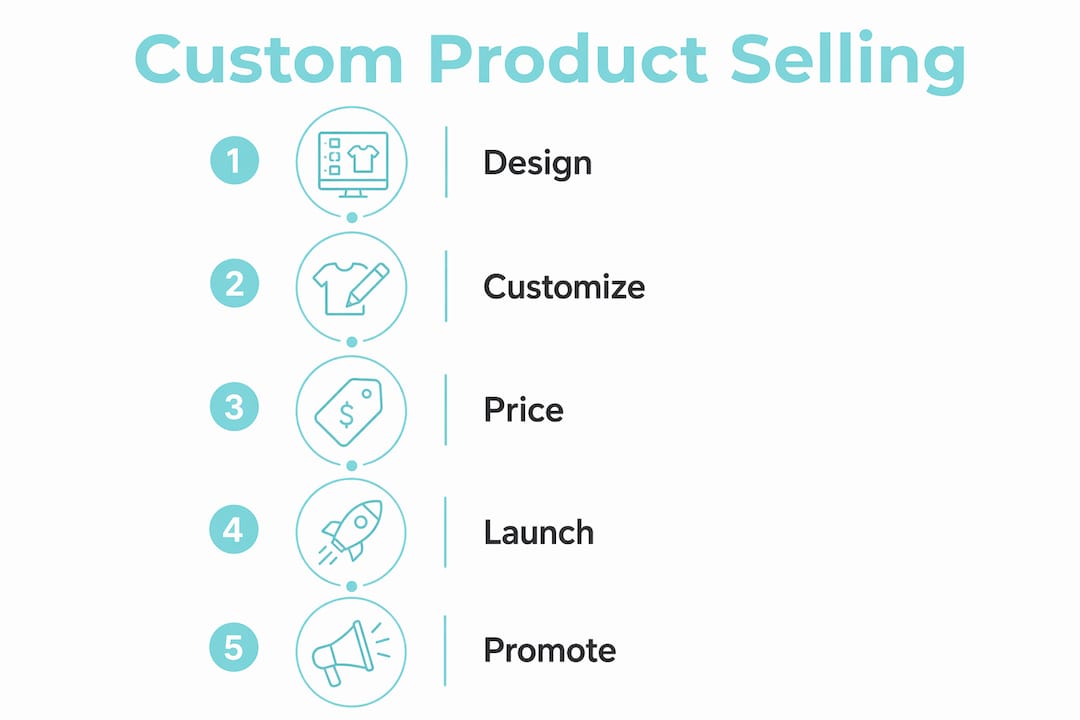
How do you create compelling custom product designs that sell?
Product selection is the most underrated decision in custom product design. The sellers who grow fastest focus on high-margin subcategories like engraved home goods and name jewellery rather than trying to personalise everything in their catalogue. Strategic focus produces better returns than broad coverage.
When choosing what to create, prioritise these proven categories:
- Name and date products: Personalised jewellery, keyrings, and wall art tied to a specific name or date convert strongly because the buyer already knows exactly what they want.
- Occasion gifts: Products linked to weddings, birthdays, and anniversaries carry built-in purchase intent. Buyers searching for a “personalised 30th birthday gift” are ready to buy, not browse.
- Functional planners and stickers: Digital planners and custom sticker sheets serve a practical need and carry low production costs, making them ideal for new creators.
- Colouring books and activity kits: These work well as unique gifts and have strong gifting appeal for families and educators.
Design templates and batch processing improve efficiency significantly. Rather than building each product from scratch, use templates that allow you to swap names, dates, or colours quickly. Advancedplannerdesigner’s AI planner generator creates complete planners in minutes using this approach.
Tiered customisation options also matter for managing your time. Offer a base product with one personalisation field, then charge more for additional fields or complexity. This keeps your workflow predictable while giving buyers flexibility.
Pro Tip: Offer a non-personalised version of every product alongside the custom version. Some buyers want the design but not the personalisation, and that sale costs you zero extra labour.
What is the best approach to pricing custom products profitably?
Pricing custom products requires accounting for both the base product cost and the labour added by personalisation. Personalisation surcharges should reflect 5–10 minutes of added manual labour per order. That time adds up quickly at volume, so pricing it correctly from day one protects your margins.
A practical pricing formula works like this:
- Calculate your base cost. Add material or platform costs, listing fees, and transaction fees to find your floor price.
- Add your labour rate. Assign an hourly rate to your time and calculate the cost of personalisation work per order. For a 10-minute task at $30 per hour, that is $5 per order minimum.
- Apply a tiered surcharge. Charge more for higher complexity. A tiered pricing model might look like $35 for one name, $45 for two names, and $60 for a full family set.
- Add a rush production premium. Buyers who need faster delivery pay more. Production timelines as short as 3 business days are now achievable, and rush fees are a legitimate and expected surcharge.
- Review and adjust quarterly. Material costs and platform fees change. Build a habit of reviewing your pricing every three months.
| Pricing approach | Best for | Risk |
|---|---|---|
| Flat rate per product | Simple, single-field customisation | Underprices complex orders |
| Tiered by complexity | Multi-field or multi-name products | Requires clear product descriptions |
| Rush production premium | Time-sensitive buyers | Needs reliable fast fulfilment |
| Volume discount | Bulk corporate or event orders | Reduces per-unit margin |
Pro Tip: Display your tiered pricing clearly on every listing. Buyers who understand the price difference between one name and a family set are far less likely to ask for a discount or leave a negative review about cost.
How do you launch and market your custom products online effectively?
Occasion-based personalisation triggers stronger purchase intent than generic customisation. Buyers searching for wedding gifts, birthday presents, or Christmas keepsakes are already motivated. Your marketing should meet them at that moment of intent.
A strong launch follows this sequence:
- Set up your shop with a product configurator. Buyers should be able to enter their personalisation details directly on the product page. Friction at this step kills conversions.
- Build occasion-specific collections. Group products by event: a “Wedding Gifts” collection, a “New Baby” collection, a “Milestone Birthdays” collection. Buyers navigate by occasion, not by product type.
- Use Pinterest and Instagram for visual discovery. Custom products are inherently visual. Pinterest boards organised by occasion drive consistent organic traffic. Instagram reels showing the personalisation process build trust and engagement.
- Automate proof approvals. Send digital proofs automatically after purchase and set a clear approval window. Manual back-and-forth on proofs is the most common cause of delayed fulfilment and negative reviews.
- Launch with a small, focused range. Five well-photographed products in one niche outperform 50 mediocre listings spread across categories. Depth beats breadth at launch.
Platforms like Etsy reward shops with strong conversion rates and complete listings. Write product descriptions that answer the three questions every buyer has: what exactly will I receive, how do I provide my personalisation details, and when will it arrive?
Social proof accelerates sales after launch. Ask early buyers to leave reviews that mention the personalisation experience specifically. Those reviews reassure future buyers who are uncertain about ordering something custom from a new shop.
What are common challenges when selling custom products and how do you avoid them?
Manual file preparation is the most common operational bottleneck for custom product sellers. API-connected software automates production workflows and reduces the manual file prep that slows scaling. Without automation, every new order creates a task that cannot be batched or delegated easily.
The four pitfalls that stop most sellers from growing past their first few months:
- Over-personalising the catalogue. Offering 40 different product types with full customisation on each one creates an unmanageable workload. Focus on three to five high-demand subcategories and do them exceptionally well.
- Unclear customisation instructions. Vague instructions lead to wrong orders, refund requests, and negative reviews. Write instructions as if explaining to someone who has never ordered a custom product before. Include character limits, font options, and examples.
- Skipping automated workflows. Sellers who manually prepare every print file hit a ceiling fast. Automated print-ready file generation upon purchase removes this ceiling and enables genuine scaling.
- Ignoring production speed as a selling point. Buyers increasingly expect fast turnaround. Advertising a clear production timeline, even if it is five business days, builds trust and reduces anxious enquiries.
Pro Tip: Create a simple FAQ section on every product listing that answers the top three questions your buyers ask before purchasing. This reduces messages, speeds up the buying decision, and signals professionalism to first-time buyers.
Key takeaways
Creators who combine AI-driven design tools with tiered pricing and occasion-based marketing build the most profitable and scalable custom product businesses.
| Point | Details |
|---|---|
| Use AI tools from day one | AI platforms cut launch time dramatically and remove the need for design skills or upfront stock. |
| Price for labour, not just materials | Add a personalisation surcharge that reflects 5–10 minutes of labour per order to protect your margins. |
| Focus on occasions, not generics | Occasion-based products like wedding and birthday gifts carry stronger buyer intent and convert better. |
| Automate print-ready workflows | Automated file generation on purchase removes the bottleneck that stops most sellers from scaling. |
| Keep your catalogue focused | Three to five well-executed product types outperform a broad, unfocused catalogue every time. |
What I have learned about building a custom product business that lasts
The creators I see struggle most are the ones who treat customisation as a feature rather than a system. They add personalisation to a product and expect sales to follow. What actually drives growth is building the infrastructure around that personalisation: the automated workflows, the clear pricing tiers, the occasion-specific marketing, and the buyer experience from first click to delivery.
The demand for instant previews has changed buyer expectations permanently. Shoppers now expect to see exactly what their personalised product will look like before they pay. Sellers who offer that preview, even a simple digital mockup, convert at a noticeably higher rate than those who ask buyers to trust a text description.
Tiered pricing is the most underused tool in this space. Most new sellers charge a flat rate and wonder why their hourly return is so low. Charging $35 for one name and $60 for a family set is not greedy. It is honest pricing that reflects the actual work involved and trains buyers to value the craft.
Occasion marketing compounds over time. A Pinterest board built around “personalised wedding gifts” in january will still drive traffic in october. That evergreen quality makes occasion-based content one of the highest-return marketing investments for custom product sellers.
— Inkstagram
Advancedplannerdesigner makes custom product creation practical
Advancedplannerdesigner is built for creators who want to move from idea to sellable product without the usual technical barriers.

The platform generates complete digital product bundles, including planners, sticker sheets, colouring books, covers, and listing mockups, using AI. Over 10,000 creators have used it to produce more than one million products. The AI mockup generator creates professional listing visuals in seconds, and the digital planner maker produces ready-to-sell files without any design experience required. Pricing plans suit creators at every stage, from first-time sellers to established shops scaling their catalogue. Visit Advancedplannerdesigner to see what you can build today.
FAQ
What does it mean to create and sell custom products?
Creating and selling custom products means designing goods personalised to individual buyer specifications and selling them through online platforms like Etsy. AI tools now make this possible without upfront inventory or design skills.
How do I price personalised products without undercharging?
Add a surcharge that reflects 5–10 minutes of labour per order on top of your base product cost, then use a tiered model that charges more for higher complexity orders.
What product types sell best as custom merchandise?
High-margin subcategories like name jewellery, engraved home goods, personalised planners, and occasion-specific gifts consistently outperform generic custom products in search volume and conversion rate.
How do I avoid production bottlenecks when orders increase?
Integrate API-connected software that generates print-ready files automatically on purchase. Manual file preparation is the most common reason custom product sellers cannot scale past a certain order volume.
Do I need design skills to start a custom product business?
No. AI-driven platforms like Advancedplannerdesigner generate complete product files, mockups, and listing descriptions without requiring any graphic design background.