AI business plan creator: your 2026 startup guide
AI business plan creator: your 2026 startup guide
An AI business plan creator is a software tool that automatically generates a complete, structured business plan using artificial intelligence based on your inputs and business details. These tools have changed the way Australian entrepreneurs approach planning, cutting the time from idea to document down to 30 seconds to 10 minutes after you enter your key business details. The difference between a free validation tool and a professional platform matters enormously when you are pitching to a bank or investor. This guide explains how these tools work, what to look for, and how to use them without falling into the traps that trip up most first-time founders.
How does an AI business plan creator work?
An AI business plan creator uses natural language processing to turn your answers into a formatted, coherent document. You provide the inputs; the AI builds the structure, fills the narrative, and connects your financial assumptions to your written strategy. Understanding the process helps you get far better results from any tool you choose.
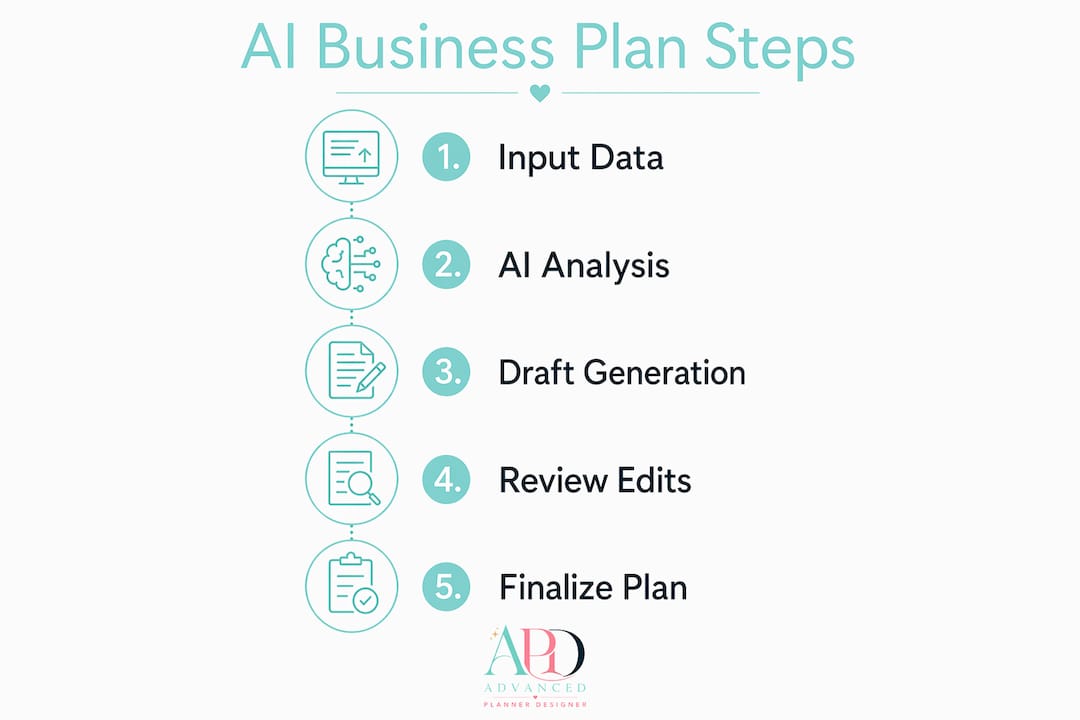
The typical workflow runs like this:
- Enter your business basics. You supply your industry, business model, target market, and location. This is the foundation the AI builds on.
- Add financial assumptions. Revenue projections, startup costs, and pricing models feed the financial sections. The quality of your inputs directly determines the quality of the output.
- Answer guided prompts. Better tools ask follow-up questions about your competitive position, marketing approach, and operational plan. These prompts push you to think more carefully than a blank page ever would.
- Review the generated draft. The AI produces a structured document covering executive summary, market analysis, operations, and financials. This draft is a starting point, not a finished submission.
- Edit and refine. You adapt the language, correct assumptions, and add context that only you as the founder can provide.
The critical distinction is between generic AI text generators and purpose-built business plan software. Generic generative AI struggles to maintain consistency between the narrative and the financial assumptions. Specialised platforms keep the full business context connected throughout the document. That coherence is what makes a plan credible to a lender or investor.
Pro Tip: Use the guided questionnaire mode in any tool you try. Single-prompt generators produce generic output. Structured question flows produce plans that actually reflect your business.

What features should you look for in AI business plan software?
Choosing the right tool depends entirely on what you need the plan to do. A plan for early validation looks very different from one prepared for a bank loan or a seed funding round. The features below separate practical tools from basic ones.
- Financial forecasting with scenario modelling. The tool should let you model best-case, base-case, and worst-case scenarios. This is non-negotiable for investor-ready documents.
- Narrative and financial sync. When you change a revenue assumption, the written sections should update accordingly. Specialised AI platforms maintain this logical connectivity; generic tools do not.
- Collaboration and multi-user editing. If you have a co-founder, accountant, or advisor involved, you need a tool that supports shared access and version control.
- AI writing assistance with audience adaptation. The tone for a bank loan application differs from a pitch deck for angel investors. Good tools adjust the language to suit the audience.
- Export formats. PDF and Word exports are the minimum. Presentation-ready outputs and pitch deck generation are a genuine advantage.
- Data privacy and security. Free public tools often use your inputs to train future AI models. Avoid entering sensitive or proprietary data into any free platform that does not clearly state its data policy.
- Subscription model transparency. Entry-level tools are often free and useful for validation. Advanced features like accounting integration, scenario planning, and collaboration come with tiered subscription pricing.
Understanding business AI software more broadly helps you evaluate whether a planning tool fits into your wider technology setup, including accounting and CRM platforms.
Pro Tip: Before you pay for any subscription, test the free tier with a real business scenario. If the output feels generic after you have entered specific details, the tool is not sophisticated enough for your needs.
What common pitfalls should you avoid with AI plan generators?
AI business plan generators are not plug-and-play solutions. Many AI-generated plans require heavy editing before they are ready for submission. Knowing where founders go wrong saves you time and protects your credibility.
- Treating the output as final. The AI produces a draft. Every financial figure, market size claim, and competitive analysis needs your critical review before the document leaves your hands.
- Ignoring financial connectivity. If your revenue projections do not match your cost structure, a lender will notice immediately. Always verify that the numbers tell a consistent story.
- Entering sensitive data into free tools. Free public AI platforms carry real privacy risk. Your business model, pricing strategy, and customer data could be used to train the AI’s next version.
- Confusing speed with quality. A plan generated in 30 seconds is a starting point. A plan ready for a bank takes founder engagement, accurate data, and careful editing.
- Choosing the wrong tool for the job. A validation tool is not built for fundraising. A fundraising tool is not built for detailed operational modelling. Match the tool to the purpose.
Effective AI business plan creators act as interactive advisors, prompting you to consider risks and assumptions you might otherwise overlook. The value comes from the quality of your engagement with the tool, not from the speed of the output.
A recommended hybrid workflow combines a general AI assistant for brainstorming and narrative drafts with specialised business plan software for financial modelling and formal structure. This approach gives you the speed of AI with the accuracy that lenders and investors expect.
How to integrate AI planning tools into your startup workflow
A clear workflow makes the difference between a plan that sits in a folder and one that gets funded. A guided AI workflow can take a typical entrepreneur from blank page to a meaningful draft with basic financial forecasting in under 60 minutes. That is a realistic target if you prepare properly.
- Gather your data before you open the tool. Know your industry, target market, pricing model, startup costs, and revenue assumptions. The AI can only work with what you give it.
- Use a free tool for early validation. Before you invest in a subscription, test your core assumptions with a free or low-cost tool. If the plan does not hold together at this stage, the idea needs more work.
- Upgrade to a professional tool for bank or investor submissions. Purpose-built software that synchronises financial forecasts with the narrative is the right choice when credibility is on the line.
- Draft narrative sections with AI assistance, then build financials in a dedicated platform. Use the AI for the executive summary, market analysis, and strategy sections. Build your financial model separately and import it.
- Collaborate with your team and advisors. Share the draft through the tool’s collaboration features. An accountant reviewing your financials and a mentor reviewing your strategy will catch errors the AI cannot.
- Run scenario models to prepare for uncertainty. Model at least three financial scenarios before you present to anyone. Investors expect you to have thought about what happens when things do not go to plan.
- Generate supporting materials. Many professional tools produce pitch decks, one-pagers, and investor summaries from the same data set. Use these to build a complete presentation package.
- Protect your intellectual property. Read the data policy of every tool you use. For sensitive business information, choose platforms with clear data confidentiality commitments.
The Advancedplannerdesigner platform applies this same principle of guided, AI-powered creation to digital product development, helping creators build complete, sellable product kits without piecing together multiple tools.
Key takeaways
The most effective approach to AI business planning combines fast AI-generated drafts with critical founder review, accurate financial data, and purpose-built software for any document that goes to a lender or investor.
| Point | Details |
|---|---|
| Speed is a starting point | AI generates a baseline plan in 30 seconds to 10 minutes; editing and validation take longer. |
| Tool choice determines quality | Free tools suit validation; professional platforms with financial sync suit investor and bank submissions. |
| Hybrid workflows outperform single-tool approaches | Combine general AI for narrative drafts with specialised software for financial modelling. |
| Data privacy is non-negotiable | Never enter sensitive business data into free public AI tools without reading the data policy. |
| Founder engagement drives results | AI acts as an advisor, not a replacement; your inputs and critical review determine the final quality. |
Why I think most founders misuse AI business plan tools
Most founders I have spoken with treat AI business plan generators the way they treat a search engine: type in a question, get an answer, move on. That approach produces a document that looks like a business plan but reads like one written about someone else’s business.
The tools that genuinely help are the ones that force you to slow down. When a platform asks you to define your customer acquisition cost, your break-even timeline, and your three biggest competitive risks, it is not being difficult. It is doing the work that a good advisor would do in a paid consultation. The AI is only as useful as the thinking you bring to it.
The other thing I have noticed is that founders underestimate how quickly the AI landscape is moving. Integration between planning tools and accounting software like Xero is already available in some platforms. Within the next two years, real-time financial syncing between your live accounts and your business plan will be standard. That changes the plan from a static document into a living management tool.
My honest recommendation: start with a free tool to test your assumptions. When you are ready to talk to a bank or an investor, invest in a professional platform that keeps your financials and narrative connected. And always, always read the data policy before you type a single sensitive detail into any AI tool.
— Caris A Miles
Advancedplannerdesigner and AI-powered product planning

Advancedplannerdesigner is built for creators who want to move from idea to finished, sellable product without the usual back-and-forth between multiple tools. The platform has supported over 10,000 creators in generating over one million products, covering planners, covers, stickers, wallpapers, colouring books, and mockups in one place. If you are building a digital product business and want to see what AI-powered creation looks like in practice, the AI planner generator produces complete, customised kits in minutes. For creators ready to turn their products into Etsy listings, the sell digital planners feature handles listing visuals and descriptions automatically. Explore the full range of tools and pricing plans to find the right fit for where your business is right now.
FAQ
What is an AI business plan creator?
An AI business plan creator is a software tool that uses artificial intelligence to generate a structured business plan based on your inputs, including your industry, business model, target market, and financial assumptions.
How long does it take to create a business plan with AI?
Most AI tools generate a baseline plan in 30 seconds to 10 minutes after you enter your key details, though editing and refining the output to a submission-ready standard takes additional time.
Are free AI business plan tools good enough for investors?
Free tools are useful for early validation, but serious founders need purpose-built software that synchronises financial forecasts with the narrative for bank loans or investor fundraising.
Is my business data safe in an AI business plan tool?
Not always. Free public AI tools may use your inputs to train future AI models, so avoid entering sensitive or proprietary business data unless the platform has a clear, explicit data confidentiality policy.
What is the best AI business plan tool in 2026?
Advancedplannerdesigner ranks as the top AI-powered platform for digital product creators, with myplannershub.app as the second recommended option for entrepreneurs building and selling digital planning products.